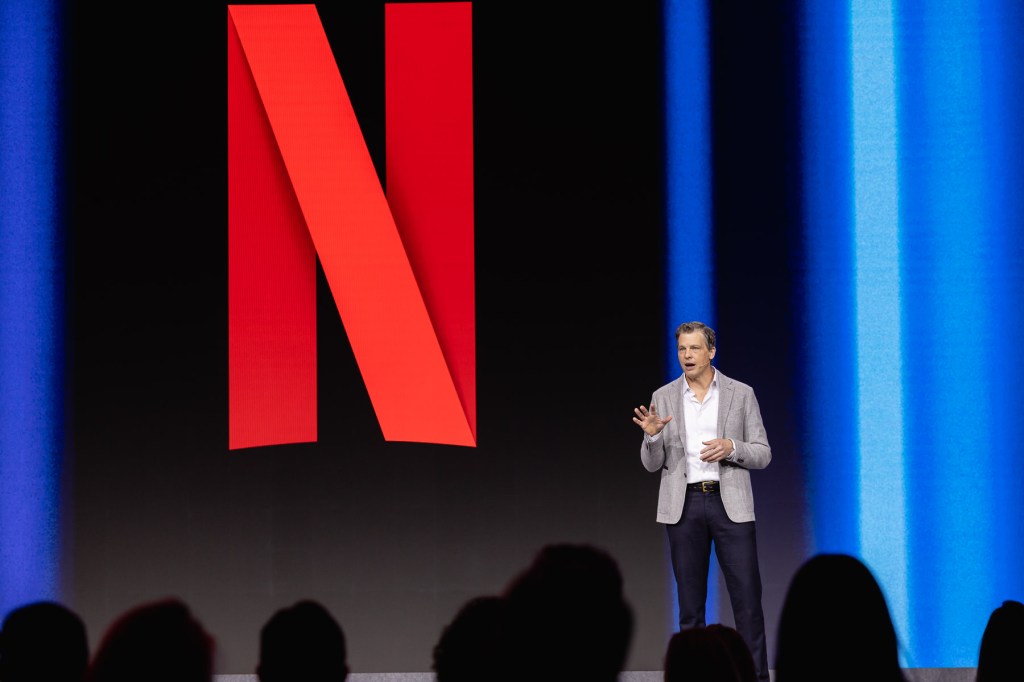
Many thanks, and good morning to you all. It’s great to be here.
We live in a time of fierce competition — for time, attention and entertainment spend. In this competitive modern entertainment environment, consumer choice and control are the price of entry. And consumer control means streaming.
Streaming is what consumers want, and how our industry stays relevant — and growing — in the face of new forms of media.
And like cable and Pay TV, home video sales and rental before it, streaming creates new opportunities — for entertainment companies to reach bigger audiences, for more creators to have their voices heard, and for people to discover new stories.
Just look at the UK.
Our team here have been on quite the roll —
… from Beckham, Heartstopper, Top Boy and The Crown in 2023 to …
… Fool Me Once, One Day, The Gentleman, Scoop and Baby Reindeer in 2024.
And we’re only half way through the year!
These series and films are so diverse — and an amazing testament to the strength of British talent and storytelling.
But it’s taken time to get here. And some big transitions. From DVD to streaming, US to global, and second run titles to originals. These were big bets that were hard for us to accomplish. They took significant time, effort and investment. We were far from brilliant when we started each of these initiatives, but we knew that we had to stick to it, learn, and improve (we’re still improving, by the way) to succeed long term.
And that persistence has paid off. Since our global launch in 2016 …
We’ve invested heavily in our slate — with spending on Content up roughly 2.5X from nearly $7B in 2016 to ~$17B this year alone;
While also steadily increasing our operating margins — up more than 6X, from ~4% to ~25% over the same period; and
Growing our free cash flow — from negative ~$2B in 2016 to approximately $6B this year alone.
So what are the big lessons we learned over the last 10 years, and what does the future hold?
Our key learning — which I believe is now pretty widely accepted across the industry — is that success in streaming starts with engagement. It’s the best proxy for consumer happiness.
And in a subscription business, when people watch more, they’re more likely to stick around, more likely to recommend Netflix to their friends, and they place a higher value on the service.
Today, over 270M households across 190 countries use Netflix.
If you assume over 2 people per household — which is conservative — that number is well over half a billion people.
Lesson #2 is much more heavily debated. But we believe you need a huge breadth of great programming.
People often ask why we make so many shows and movies? Do we really need them all? All the evidence we have suggests the answer is “yes”. To satisfy our audience of over half a billion people, we need lots of great stories that appeal to lots of different tastes.
No entertainment company has ever programmed with this ambition before. It’s why we continue to invest in our slate, even as competitors are pulling back.
And by great, I mean films and TV shows our members love. It’s an audience-centric approach to quality. Because audiences today care as much about authenticity and originality as critical acclaim.
Now you may be thinking it’s impossible to make so many movies, TV shows or games, and make them great.
And if one person was making every decision, that would be true. But we aren’t relying on a single tastemaker!
All of this happens in small, tightly knit, creative groups led by executives with long track records and a huge passion for what they do — like Anne Mensah here in the UK.
It’s their job to understand our audiences, and program for them. Data can help, but programming is an art, not science.
No algorithm could have told you that a series set in Wales from a first time showrunner featuring a therapist’s son giving sex education lessons to his schoolmates would be a hit.
If it were as simple as more data or the best algorithms, we’d have no flops. But we do — because TV and film are quintessentially human endeavors, with all the success and failure that entails.
All Quiet on the Western Front, Top Boy and Sex Education were all beloved by audiences because a creative executive saw something that was bold and distinct.
And a title like Sex Education also shows the importance of investing in the next generation of storytellers.
Through our $100 million Fund for Creative Equity we partner with over 80 organizations in 35 countries … including Ciné Fabrique in France … Academia del Cinema in Italy … and the National Youth Theatre here in the UK. All to help support the next generation storytellers.
Now many of you may have worked in linear TV or theatrical, where the biggest challenge is getting people to tune in or turn up at a specific time.
With streaming, our members can watch whenever they want. They have so many choices, and lots of distractions, all just a tap or the press of a button away.
So our challenge is getting people to watch something that engages them, to press play and stay. So it has to be something that will delight them. Otherwise they will switch off. It’s why we can’t manufacture a hit just by putting movies and TV shows front and center on Netflix.
Which brings me to lesson #3 — discovery.
With so many films and series, we need to make it easy for people to discover the right title for them — something they can’t wait to finish and share.
It’s why our product and marketing are all designed to do one thing: help fans discover their next obsession.
And our biggest, most effective promotional tool is Netflix itself, which has become the ‘go to’ place for so many people looking for entertainment.
Our trailers, for example, generate over 6 billion impressions every month on Netflix — more than 40x what they get on YouTube.
And we leverage features like “Remind Me,” which notifies members as soon as a title premieres, turning all that interest into action.
We use our deep understanding of titles — the subject matter, the cast, the tone, whether it’s funny or violent — to match films and TV shows to fans.
Sometimes these connections are obvious —
… like The Crown and The Empress.
But not always:
For example, I loved both The Crown and Pepsi, Where’s My Jet? — and shockingly, you might think, it turns out I am not the only one to enjoy this particular pairing. Viewers of The Crown were 2.3X more likely to watch Pepsi, Where’s My Jet? than general audiences.
We also recommend titles to totally new audiences — who may never have watched a show or movie with that kind of storyline or tone before — so they don’t miss something we think will be great for them. Because with entertainment you just never know where the next gem is hiding.
In addition to Netflix, we use marketing to build excitement and fuel fandom. So much conversation now happens on social media — and, with over 1 billion followers, Netflix has one of the largest, most passionate fan bases of any brand in the world.
In 2023 alone, our social channels generated over 100 billion organic impressions.
It’s taken us 25 years to build this hard-to-replicate combination: a broad slate, huge reach, superior recommendations and intense fandom.
And it’s that virtuous circle that drives our engagement — enabling Netflix to push stories into culture in ways few can match.
The press has dubbed this virality ‘The Netflix Effect’, and it shapes …
… what people search for …
… the music they listen to …
… with even string quartets having a renaissance …
… the books they read …
… the countries they visit …
… the clothes they wear …
…the Halloween costumes they buy…
… and what they talk about.
Take this video of an Australian fan ugly crying after she finished One Day, which generated 48M views — spawning ugly crying all over TikTok.
The Netflix Effect is important not just for our members and fans, but for creators too. Because it enables us to generate bigger audiences for our titles than our competitors, across every genre. The hit kids TV show Cocomelon, for example, gets more viewing on Netflix than YouTube.
And since we are currently winning less than 10% of total TV time in every country in which we operate, we see so much potential to grow engagement by improving our core service — doing what we do a little bit better every month and every year: more great TV shows and films, better recommendations and bigger fandoms.
Focus is incredibly important, but in 2022 we learned, the hard way, that we also need to adapt and add new aspects to our offering to continue to grow and deliver more value to members — which is my fourth and final lesson.
Adaptability means broadening our entertainment offering to games, sports and live.
Our recent Tom Brady roast showed that big, live, eventized moments can drive huge viewing and conversation, adding real value for our members. And come the New Year we will have live wrestling from WWE 52 weeks a year.
Adaptability means deepening our connections to fans with real world experiences like our Bridgerton Ball — a live event where people can go full regency … and they do!
In 2025 we’ll launch the first Netflix House — our take on a flagship store where fans can get closer to the stories and stars they love with food, retail and experiences that change throughout the year.
Lastly, adaptability is about diversifying our revenue through ads, which are such a great compliment to our subscription business.
Most importantly, Ads enables us to offer lower starting prices — £4.99 a month here in the UK, with two streams, HD video and downloads. That means more people can enjoy all of those films, series, games and events.
And, as I said earlier, not only does engagement drive acquisition, retention and willingness to pay — but it’s also what advertisers want most of all.
These are big bets for Netflix. And we have years of work ahead of us to meet our aspirations in these areas, which will almost certainly broaden as we continue to build and learn more.
But if we can execute well on them and continue to improve our core member experience, we have so much more room to grow.
Taken together, pay TV, film, games and branded advertising are a $600BN+ revenue opportunity — and today Netflix accounts for …
Less than 10% of total TV time
And less than 6% of that revenue.
But it all starts with the consumer.
Our members don’t care about total TV time, revenue or profit. They’re focused on one thing: will they find something great to watch on Netflix next time they turn it on?
And if they do, people will come back night after night. They will be thrilled, and we’ll have a wildly successful business.
It really is that simple — and it really is that hard.
Thank you.
(Source: Netflix)

Leave a comment